Six Reckoning vectors are pulling toward systemic stress. Five Abundance vectors are pushing toward breakthrough. Both are real. Both arrive in the same five-year window. The R2A thesis is built for the tension between them — and the investing framework it generates is simple: Survive the Reckoning. Thrive in what holds across both. Build on the Abundance.
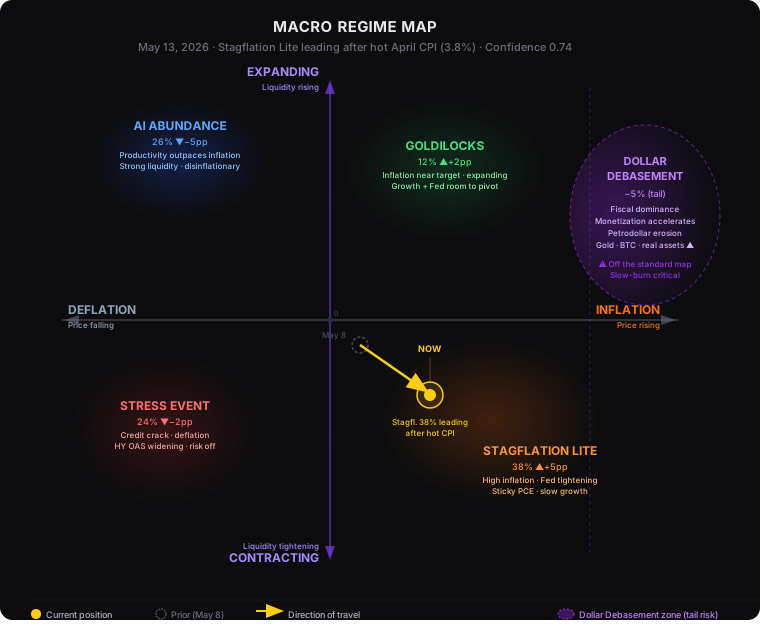
Five regimes plotted across two axes: liquidity (expanding or contracting) and inflation (deflation or inflation). Each regime has a probability, a position on the map, and a different set of assets that win and lose. The yellow dot is where R2A reads the economy now. The arrow shows direction of travel over the last week.
Two trajectories arriving in the same window — the Reckoning pulling toward systemic stress, Abundance pushing toward breakthrough. R2A's framework holds both in view at once. Every sector view, every name call sits inside this frame.
Interest costs become the second-largest line item in the federal budget by 2028. Crowds out everything else. Either inflated away or rolled at higher rates indefinitely. Bond market becomes the binding political constraint.
Boomers retiring in peak numbers through 2030. Net savers turn net spenders. Healthcare consumption inflects. Labor force participation falls structurally. Real wages for the median worker rise, but the entitlement math doesn't pencil.
Cognitive labor automates first, faster than the political system can absorb it. White-collar displacement begins in 2026–27, hits broadly by 2029. Productivity gains accrue to capital. The income distribution problem becomes the central political fight.
US security guarantees become explicitly transactional. Allies hedge. Multiple regional powers rearm simultaneously. Taiwan, Korea, Eastern Europe, the Gulf all become first-order risks rather than tail risks. Defense capex is structural, not cyclical.
Both parties lose the median voter. Outsider candidacies become the norm. Tax policy, immigration, and antitrust all become unpredictable from cycle to cycle. Capital responds by demanding higher risk premia from the United States itself.
Democratic backsliding extends globally. Surveillance capacity becomes infrastructure. Capital controls return in places they haven't been in 30 years. The "rules-based international order" becomes a phrase used only in press releases.
Hyperscaler capex over $320B in 2026 — funded out of operating cash, not credit cycles. Training compounds into inference. Productivity gains accrue to capital first and eventually to labor. The most funded technical transformation ever attempted.
Foundation models close the autonomy gap robotics has had for two decades. Humanoid units in BMW pilot lines. Surgical robots compounding. Autonomy stacks rolling into mining, trucking, and agriculture. The physical layer of the AI economy goes live.
Cost-to-orbit down 85% in 15 years and still bending. Direct-to-cell broadband from space. Daily Earth imagery as commodity. Lunar logistics emerging. A $1T-plus addressable market visible by 2030.
In-vivo CRISPR programs reading positive in trials. RNAi platforms generating $5B+ revenue. GLP-1 extending into a dozen indications. AI drug discovery producing real molecules. Biology becomes engineering.
SMRs clear regulatory milestones. Grid storage scales. Existing nuclear runs hotter. Solar continues to bend down. The unsexy infrastructure that has to scale before AI can — and now is. The power constraint becomes a passing concern.
Each regime has a different probability, different drivers, and a different set of assets that win and lose. The percentage ranges below are general portfolio guidelines for readers who carry conviction toward a given regime — not specific allocations. Use them as a frame, not a prescription.
R2A's calls are weighted across all five regimes by the probabilities above. A reader replicating R2A's stance would tilt toward Stagflation Lite (the current leader) with a meaningful weight on AI Abundance, preparation for a Stress Event, and a smaller hedge against Dollar Debasement. But your conviction may differ — pick the regime(s) you weight most and let the ranges guide your asset mix. The ranges above are general portfolio frames for readers, not R2A's own allocations.
A frame for how to think about portfolio construction across all five regimes at once. Each bucket maps to a different goal and a different range of the portfolio. Together they should add up to a whole portfolio that doesn't depend on one regime winning.
Position to not get blown up if a Stress Event or Dollar Debasement plays out. Capital preservation, monetary metal (gold), long-duration Treasuries as a deflation hedge, Bitcoin and real assets if the dollar erodes structurally. The point is to still be in the game when better odds appear.
Range guideline: 15–25% of the portfolio.
Typical mix: gold, short-duration cash equivalents, defensive quality equity, optional Bitcoin sleeve.
Quality compounders that work across regimes. Pricing power, structural growth, low refinancing risk. Companies whose business model doesn't depend on a benign macro to keep compounding. On R2A Intel these are the platforms (MSFT, AMZN, GOOGL), aerospace components compounders (HEI, TDG, HWM), medical-device franchises (ISRG, ALNY).
Range guideline: 45–60% of the portfolio.
Typical mix: mega-cap platforms, high-quality compounders, dividend aristocrats with pricing power.
The Abundance bets — names where the moonshot scenario is plausible and the prize is categorically big. Sized as optionality, not core. Robotics, space, gene editing, quantum, advanced energy. Most won't work; the ones that do pay for the rest of the basket many times over.
Range guideline: 20–35% of the portfolio.
Typical mix: a basket of small positions across abundance themes. Sized so no single name dominates.
The indicators that would shift the probabilities above.
None of these are predictions. They're the data R2A updates the probabilities against. When an accelerator fires, positioning shifts. When two fire at once, the macro read changes.